Tuesday, February 17, 2009

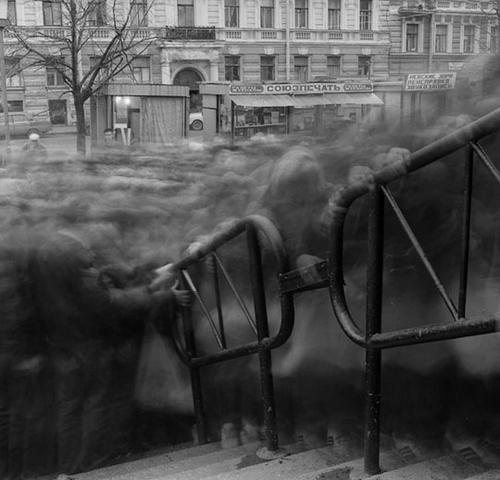
Long-exposure shots in St Petersburg, Russia turn people into ghosts


Alexey Titarenko's "City of Shadows" is a series of haunting, gorgeous long-exposure shots of street-scenes in St Petersburg, Russia. The long exposure-times turn the people in the shots into ghosts and suggestions of motion

Starting your own country on the open sea


How would you start your own country, with its own government, low taxes and a civilized way of life? With freedoms eroding around the world, with speed cameras and invasive laws, this seems like a key question.

Patri Friedman, grandson of legendary economist Milton, puts it like this:

"Government is an industry with a really high barrier to entry," he said. "You basically need to win an election or a revolution to try a new one. That's a ridiculous barrier to entry. And it's got enormous customer lock-in. People complain about their cellphone plans that are like two years, but think of the effort that it takes to change your citizenship."

Previous efforts at starting micronations have run afoul of nearby governments, and plopping your new country into the San Francisco Bay Area, with some of the highest living costs in the nation, seems a bit cheeky. Surely that is US territory, not the high seas.

But one thing for sure: Government is ossified, corrupt and dysfunctional pretty much everywhere. Having a world of floating platforms where you could change your government as easily as motoring to another location seems like a compelling way to organize society.

But as a threat to existing governments, it's cheeky ... and likely to be prosecuted vigorously.

Sunday, February 8, 2009

Most Functional Folding Knife


Leave it to those ingenious Chinese folks to out-Switzerland the Swiss. The world record-setting Wei Ge knife pictured above includes 87 tools with an intended 141 individual functions. It is the first pocket knife designed to entirely defeat the structural integrity of any pocket that attempts to carry it. Among its many features are a hex screw, carabiner, Wankel rotary engine, flux capacitor, and nail file.

It is unclear if the manufacturer of this knife is a chinese company called Wei Ge, or if it is the Chinese company Weierman that registered the trademark "Wei Ge" (a statement that translates to "Great Man" and was later licensed to pharmaceutical companies selling drugs for erectile dysfunction).

All we know for certain is that a manly Chinese company that may or may not have boner issues designed a Swiss Army knife so amazingly functional that it cannot possibly be used for anything. There is a lesson to be learned there, but we're not sure what it is.

Chernobyl Accident

(May 2008)
  • The Chernobyl accident in 1986 was the result of a flawed reactor design that was operated with inadequately trained personnel and without proper regard for safety.
  • The resulting steam explosion and fire released at least five percent of the radioactive reactor core into the atmosphere and downwind.
  • 28 people died within four months from radiation or thermal burns, 19 have subsequently died, and there have been around nine deaths from thyroid cancer apparently due to the accident: total 56 fatalities as of 2004.
  • An authoritative UN report in 2000 concluded that there is no scientific evidence of any significant radiation-related health effects to most people exposed. This was confirmed in a very thorough 2005-06 study.

The April 1986 disaster at the Chernobyl nuclear power plant in the Ukraine was the product of a flawed Soviet reactor design coupled with serious mistakes made by the plant operators in the context of a system where training was minimal. It was a direct consequence of Cold War isolation and the resulting lack of any safety culture.

NB: "Chernobyl" is the well-known Russian name for the site; "Chornobyl" is preferred by Ukraine.


Reactor diagram.

Source: OECD NEA

The accident destroyed the Chernobyl-4 reactor and killed 30 people, including 28 from radiation exposure. A further 209 on site and involved with the clean-up were treated for acute radiation poisoning and among these, 134 cases were confirmed (all of whom apparently recovered). Nevertheless 19 of these subsequently died from effects attributable to the accident. Nobody off-site suffered from acute radiation effects. However, large areas of Belarus, Ukraine, Russia and beyond were contaminated in varying degrees.

The Chernobyl disaster was a unique event and the only accident in the history of commercial nuclear power where radiation-related fatalities occurred.* However, its relevance to the rest of the nuclear industry outside the then Eastern Bloc is minimal.

* There have been fatalities in military and research reactor contexts, eg Tokai-mura.

The accident

On 25 April, prior to a routine shut-down, the reactor crew at Chernobyl-4 began preparing for a test to determine how long turbines would spin and supply power following a loss of main electrical power supply. Similar tests had already been carried out at Chernobyl and other plants, despite the fact that these reactors were known to be very unstable at low power settings.

A series of operator actions, including the disabling of automatic shutdown mechanisms, preceded the attempted test early on 26 April. As flow of coolant water diminished, power output increased. When the operator moved to shut down the reactor from its unstable condition arising from previous errors, a peculiarity of the design caused a dramatic power surge.

The fuel elements ruptured and the resultant explosive force of steam lifted off the cover plate of the reactor, releasing fission products to the atmosphere. A second explosion threw out fragments of burning fuel and graphite from the core and allowed air to rush in, causing the graphite moderator to burst into flames.

There is some dispute among experts about the character of this second explosion. The graphite - there was over 1200 tonnes of it - burned for nine days, causing the main release of radioactivity into the environment. A total of about 14 EBq (1018 Bq) of radioactivity was released, half of it being biologically-inert noble gases. See also appended sequence of events.

Some 5000 tonnes of boron, dolomite, sand, clay and lead were dropped on to the burning core by helicopter in an effort to extinguish the blaze and limit the release of radioactive particles.


The damaged Chernobyl unit 4 reactor building

Immediate impact

It is estimated that all of the xenon gas, about half of the iodine and caesium, and at least 5% of the remaining radioactive material in the Chernobyl-4 reactor core (which had 192 tonnes of fuel) was released in the accident. Most of the released material was deposited close by as dust and debris , but the lighter material was carried by wind over the Ukraine, Belarus, Russia and to some extent over Scandinavia and Europe.

The main casualties were among the firefighters, including those who attended the initial small fires on the roof of the turbine building. All these were put out in a few hours, but radiation doses on the first day were estimated to range up to 20,000 millisieverts (mSv), causing 28 deaths in the next four months and 19 subsequently.

The next task was cleaning up the radioactivity at the site so that the remaining three reactors could be restarted, and the damaged reactor shielded more permanently. About 200,000 people ("liquidators") from all over the Soviet Union were involved in the recovery and clean up during 1986 and 1987. They received high doses of radiation, average around 100 millisieverts. Some 20,000 of them received about 250 mSv and a few received 500 mSv. Later, the number of liquidators swelled to over 600,000 but most of these received only low radiation doses. The highest doses were received by about 1000 emergency workers and on-site personnel during the first day of the accident.

Initial radiation exposure in contaminated areas was due to short-lived iodine-131, later caesium-137 was the main hazard. (Both are fission products dispersed from the reactor core, with half lives of 8 days and 30 years respectively. 1.8 Ebq of I-131 & 0.085 Ebq of Cs-137 were released.) About five million people lived in areas contaminated (above 37 kBq/m2 Cs-137) and about 400,000 lived in more contaminated areas of strict control by authorities (above 555 kBq/m2 Cs-137).

On 2-3 May, some 45,000 residents were evacuated from within a 10 km radius of the plant, notably from the plant operators' town of Pripyat. On 4 May, all those living within a 30 kilometre radius - a further 116 000 people from the more contaminated area - were evacuated and later relocated. About 1,000 of these have since returned unofficially to live within the contaminated zone. Most of those evacuated received radiation doses of less than 50 mSv, although a few received 100 mSv or more.

Reliable information about the accident and resulting contamination was not available to affected people for about two years following the accident. This led to distrust and confusion about health effects.

In the years following the accident a further 210 000 people were resettled into less contaminated areas, and the initial 30 km radius exclusion zone (2800 km2) was modified and extended to cover 4300 square kilometres. This resettlement was due to application of a criterion of 350 mSv projected lifetime radiation dose, though in fact radiation in most of the affected area (apart from half a square kilometre) fell rapidly so that average doses were less than 50% above normal background

Wednesday, February 4, 2009

35 Things To Avoid At Your Job Interview


As with everything in life, it can be very helpful to know NOT what to do just as much as what to do! If you’re new to job hunting, you've probably been reading about how to act during a job interview. You should also be studying how not to act.

If there’s a common complaint among many hiring agents and human resources professionals, it’s how many of today’s generation of job hunters show up for job interviews unprepared or come with a sense of entitlement. While confidence is never a bad thing, it’s not always a good idea to show up to a job interview with the wrong attitude.

Here are 35 Things To Avoid At Your Job Interview

1. Show up unprepared: Most candidates have several days to prepare for a job interview. This is plenty of time to freshen up your resume and references, and learn everything you can about the company and job for which you’re applying. Knowing the business and its major players is great way to give you the edge over other candidates.

2. Pay little attention to your appearance: Think your appearance doesn’t count? Think again! The trend may be for business casual, but it’s still proper business etiquette to wear a suit. When it comes to the job interview, it’s all about the first impression. The company wants to hire the best person to represent the business, mohawked and hardwared individuals usually don’t fit the description.

3. Have nothing to say: It’s frustrating to an interviewer to receive one syllable answers. Go into detail. Sell yourself.

4. Say too much: Give your interviewer time to talk. By monopolizing the conversation and not letting others get a word in edgewise, you’re showing yourself to be a poor listener and disrespectful to higher ups.

5. Give a sob story: No one cares how deep in debt you are. If you give your interviewers the impression you’re irresponsible or your problems are a distraction, you won’t get the job.

6. Tell jokes: A job interview isn’t the time or place to be a comedian. You need to show you’re serious about the job.

7. Lie: Don’t lie about education, qualifications, past employment or a prison record. These are all things that businesses look into nowadays. Lying during a job interview can also be grounds for dismissal later on.

8. Trash a former employer: This is one of the biggest mistakes made during interviews. When asked why they’re seeking new employment many candidates will complain about a past employer. Why would anyone want to hire a malcontent?

9. Blame problems on co-workers: If there was an incident at a past place of employment, own up to it as honestly as possible. Casting the blame on other people only makes you look worse.

10. Act too familiar with your interviewers: Don’t call your interviewers Bob and Suzy (even if it is their names). Unless invited to do otherwise, address them as Mr. Ms, Dr or another respectful title.

11. Give too many personal details: Do you think an employer would want to hire you if he finds out you like to go out and party every night or you’re getting over a drug problem? Your personal life has nothing to do with your job. Don’t divulge unnecessary details.

12. Fidget, bite your nails, drum your fingers or show nervousness: Employers are looking for confidence, especially if you’re expected to meet with clients or give presentations.

13. Chew gum: No one wants to listen to the equivalent of a cow chewing its cud.

14. Bring your breakfast, lunch or dinner: Not only is it impolite to bring a meal to the job interview, it’s the best way not to get the job. Your interviewer doesn’t want to watch you eat, nor does she want to wait until you’re finished chewing to learn the answer to her questions.

15. Be disrespectful: Even if you don’t agree, it’s best to hold your tongue. No business wants to hire someone who is disrespectful to others.

16. Turn in a messy application: If you’re asked to fill out an application, do so in a neat, tidy manner, filling in as many of the sections as possible.

17. Bring only one copy of your resume: You may have several people interviewing you. Bring several copies of resumes and other pertinent information. It’ll show you’re someone who comes prepared.

18. Sit before you’re offered a chair: Wait to be invited before sitting. You may not even be staying in that room.

19. Smoke or drink alcohol: If you’re at a lunch interview, refrain from smoking and drinking, even if invited to do so. The interviewer may be testing you. Some businesses frown upon smokers because they spend a lot of time outside and no one wants to hire someone who indulges in cocktails during his or her lunch hour.

20. Talk on your cell phone or read text messages: To not turn your cell phone or pager off for an interview is just plain rude. Your interviewer should have your complete attention.

21. Show up late: Being tardy for a job interview tells your potential bosses, you really don’t care enough to make an effort. If you have an emergency such as being caught behind a traffic accident or a subway stalling, call ahead.

22. Discuss money, time off or benefits unless an offer has been made: Though this is probably what you’re thinking about the most, you want to the potential employer to think it’s the least of your concerns. The job should be on your mind first and foremost, not the pay or vacation time.

23. Ask no questions: Your potential employer wants to know you’re interested in the job. If you don’t ask any questions, you give the impression you don’t care.

24. Bring your cute little dog on the interview: Pets don’t belong at interviews. They’re distracting and present the potential for disaster.

25. Brush hair, file nails, put on lipstick: Primp before the interview, not during.

26. Cut short the interview for another appointment: Your potential employer doesn’t expect to be your only job interview but he does expect you to block out enough time to give a complete interview. Leaving to go to another appointment is rude and tells the employer he’s not a priority.

27. Hit on the receptionist or pass your phone number to a cute guy: If you give the impression you’re more interested in dating than working you won’t get the gig.

28. Get too comfortable: Don’t put your feet up, put your arms behind your head, cross your legs or stretch them out in the aisle. A job interview isn’t the place to let your hair down.

29. Give vague answers: Don’t tap dance around issues. Answer questions to the best of your ability. If you can’t answer a straight forward question, this employer might wonder what you have to hide.

30. Use foul language: It should go without saying that foul language isn’t appropriate at an interview let alone a place of business.

31. Act as if they need you more than you need them: You’re not the only candidate. If you act smug or make the hiring agent feel inferior you won’t get the job.

32. Excuse yourself often to use the bathroom or phone: If you can’t attend the interview uninterrupted how will you do the job?

33. Forget to shake hands: A potential employer is looking for a good, firm handshake. Don’t overlook this important detail as it says a lot about your character.

34. Fail to follow up: Always follow up on the interview within a few days. It will show the employer you want the job, and also that you practice good business sense.

35. Fail to send a thank you note: It’s polite and makes a good impression.

Dear Citizens of America


In view of your failure to elect a competent President and thus to govern yourselves, we hereby give notice of the revocation of your independence, effective immediately.

Her Sovereign Majesty, Queen Elizabeth II, will resume monarchical duties over all states, commonwealths and other territories (except Kansas, which she does not fancy), as from Monday next.

Your new prime minister, Gordon Brown, will appoint a governor for America without the need for further elections. Congress and the Senate will be disbanded. A questionnaire may be circulated next year to determine whether any of you noticed.

To aid in the transition to a British Crown Dependency, the following rules are introduced with immediate effect:

1. You should look up "revocation" in the Oxford English Dictionary. Then look up "aluminium," and check the pronunciation guide. You will be amazed at just how wrongly you have been pronouncing it.

2. The letter 'U' will be reinstated in words such as 'colour', 'favour' and 'neighbour.' Likewise, you will learn to spell 'doughnut' without skipping half the letters, and the suffix "ize" will be replaced by the suffix "ise."

3. You will learn that the suffix 'burgh' is pronounced 'burra'; you may elect to spell Pittsburgh as 'Pittsberg' if you find you simply can't cope with correct pronunciation.

4. Generally, you will be expected to raise your vocabulary to acceptable levels (look up "vocabulary"). Using the same twenty-seven words interspersed with filler noises such as "like" and "you know" is an unacceptable and inefficient form of communication.

5. There is no such thing as "US English." We will let Microsoft know on your behalf. The Microsoft spell-checker will be adjusted to take account of the reinstated letter 'u' and the elimination of "-ize."

6. You will relearn your original national anthem, "God Save The Queen", but only after fully carrying out Task #1 (see above).

7. July 4th will no longer be celebrated as a holiday. November 2nd will be a new national holiday, but to be celebrated only in England. It will be called "Come-Uppance Day."

8. You will learn to resolve personal issues without using guns, lawyers or therapists. The fact that you need so many lawyers and therapists shows that you're not adult enough to be independent. Guns should only be handled by adults. If you're not adult enough to sort things out without suing someone or speaking to a therapist then you're not grown up enough to handle a gun.

9. Therefore, you will no longer be allowed to own or carry anything more dangerous than a vegetable peeler. A permit will be required if you wish to carry a vegetable peeler in public.

10. All American cars are hereby banned. They are crap and this is for your own good. When we show you German cars, you will understand what we mean.

11. All intersections will be replaced with roundabouts, and you will start driving on the left with immediate effect. At the same time, you will go metric immediately and without the benefit of conversion tables… Both roundabouts and metrification will help you understand the British sense of humour.

12. The Former USA will adopt UK prices on petrol (which you have been calling "gasoline") - roughly $8/US per gallon. Get used to it.

13. You will learn to make real chips. Those things you call french fries are not real chips, and those things you insist on calling potato chips are properly called "crisps." Real chips are thick cut, fried in animal fat, and dressed not with catsup but with malt vinegar.

14. Waiters and waitresses will be trained to be more aggressive with customers.

15. The cold tasteless stuff you insist on calling beer is not actually beer at all. Henceforth, only proper British Bitter will be referred to as "beer," and European brews of known and accepted provenance will be referred to as "Lager." American brands will be referred to as "Near-Frozen Gnat's Urine," so that all can be sold without risk of further confusion.

16. Hollywood will be required occasionally to cast English actors as good guys. Hollywood will also be required to cast English actors as English characters. Watching Andie MacDowell attempt English dialogue in "Four Weddings and a Funeral" was an experience akin to having one's ear removed with a cheese grater.

17. You will cease playing American "football." There is only one kind of proper football; you call it "soccer". Those of you brave enough, in time, will be allowed to play rugby (which has some similarities to American "football", but does not involve stopping for a rest every twenty seconds or wearing full kevlar body armour like a
bunch of Jessies - English slang for "Big Girls Blouse").

18. Further, you will stop playing baseball. It is not reasonable to host an event called the "World Series" for a game which is not played outside of America. Since only 2.1% of you are aware that there is a world beyond your borders, your error is understandable and forgiven.

19. You must tell us who killed JFK. It's been driving us mad.

20. An internal revenue agent (i.e. tax collector) from Her Majesty's Government will be with you shortly to ensure the acquisition of all monies due, backdated to 1776.

Thank you for your co-operation.
John Cleese

Tuesday, February 3, 2009

5 amazing technology in the future

5 amazing technology in the future (probably)

transparent toaster

This innovative “Transparent Toaster” concept uses special heating glass to warm a single slice of bread. Unfortunately, the glass does not reach a high enough temperature — at this time — to actually toast the bread. No word yet on if this concept will go into production.we’ll wait of course,energy saving dude! hehe.

electronic paper

Electronic paper, a thin, flexible display technology that reveals digital images in full color, was invented by Israeli company Magink. Inventables imagines that the material could be used to create a portable “origami DVD player,” which would unfold to reveal a big screen. Now you wouldnt need of a boxy portable dvd player!

self cooling beer

Tempra Technology and Crown Holdings have partnered to develop the world’s first self cooling beer can. It looks like a normal 500ml can, but features an integrated self-cooling device that reduces the “contents by a minimum of 30° Fahrenheit (16.7° C) in just three minutes.”

“When activated, the all natural desiccant contained within a vacuum draws the heat from the beverage through the evaporator into an insulated heat-sink container.”

urinal game. playing while pee-ing :p

Set back into each urinal is a pressure-sensitive display, which activates an interactive game when used. This game includes sounds and images, bringing entertainment value to where you’d least expect. It will most likely will be installed in airports and schools “with the functional purpose of improving hygiene”. I want this gadget please!! :p

The projection of the project into a museum space was conceived of as a critical-ironic measure, questioning the concept of art, but extending it at the same time

electric shoes

The Bright Walk shoes, designed my Alberto Villarreal for the safety of all nigh-time joggers. The shoes illuminate dark paths by converting the energy from walking or running into electric energy. Sensors on the soles tell the shoes to light up. Now that the issue of running safely in the dark has been addressed, wonder when they’ll come up with anti-mugging shoes to make night runs that much safer