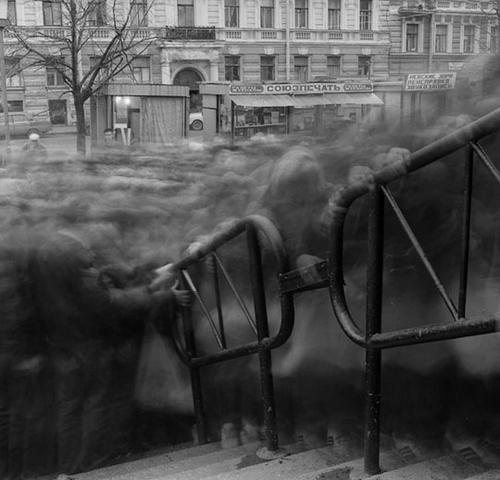
Alexey Titarenko's "City of Shadows" is a series of haunting, gorgeous long-exposure shots of street-scenes in St Petersburg, Russia. The long exposure-times turn the people in the shots into ghosts and suggestions of motion

How would you start your own country, with its own government, low taxes and a civilized way of life? With freedoms eroding around the world, with speed cameras and invasive laws, this seems like a key question.
Patri Friedman, grandson of legendary economist Milton, puts it like this:
"Government is an industry with a really high barrier to entry," he said. "You basically need to win an election or a revolution to try a new one. That's a ridiculous barrier to entry. And it's got enormous customer lock-in. People complain about their cellphone plans that are like two years, but think of the effort that it takes to change your citizenship."
Previous efforts at starting micronations have run afoul of nearby governments, and plopping your new country into the San Francisco Bay Area, with some of the highest living costs in the nation, seems a bit cheeky. Surely that is US territory, not the high seas.
But one thing for sure: Government is ossified, corrupt and dysfunctional pretty much everywhere. Having a world of floating platforms where you could change your government as easily as motoring to another location seems like a compelling way to organize society.
But as a threat to existing governments, it's cheeky ... and likely to be prosecuted vigorously.

Leave it to those ingenious Chinese folks to out-Switzerland the Swiss. The world record-setting Wei Ge knife pictured above includes 87 tools with an intended 141 individual functions. It is the first pocket knife designed to entirely defeat the structural integrity of any pocket that attempts to carry it. Among its many features are a hex screw, carabiner, Wankel rotary engine, flux capacitor, and nail file.
It is unclear if the manufacturer of this knife is a chinese company called Wei Ge, or if it is the Chinese company Weierman that registered the trademark "Wei Ge" (a statement that translates to "Great Man" and was later licensed to pharmaceutical companies selling drugs for erectile dysfunction).
All we know for certain is that a manly Chinese company that may or may not have boner issues designed a Swiss Army knife so amazingly functional that it cannot possibly be used for anything. There is a lesson to be learned there, but we're not sure what it is.
The April 1986 disaster at the Chernobyl nuclear power plant in the Ukraine was the product of a flawed Soviet reactor design coupled with serious mistakes made by the plant operators in the context of a system where training was minimal. It was a direct consequence of Cold War isolation and the resulting lack of any safety culture.
NB: "Chernobyl" is the well-known Russian name for the site; "Chornobyl" is preferred by Ukraine.

 Reactor diagram.
Source: OECD NEA
The accident destroyed the Chernobyl-4 reactor and killed 30 people, including 28 from radiation exposure. A further 209 on site and involved with the clean-up were treated for acute radiation poisoning and among these, 134 cases were confirmed (all of whom apparently recovered). Nevertheless 19 of these subsequently died from effects attributable to the accident. Nobody off-site suffered from acute radiation effects. However, large areas of Belarus, Ukraine, Russia and beyond were contaminated in varying degrees.
The Chernobyl disaster was a unique event and the only accident in the history of commercial nuclear power where radiation-related fatalities occurred.* However, its relevance to the rest of the nuclear industry outside the then Eastern Bloc is minimal.
* There have been fatalities in military and research reactor contexts, eg Tokai-mura.
The accident
On 25 April, prior to a routine shut-down, the reactor crew at Chernobyl-4 began preparing for a test to determine how long turbines would spin and supply power following a loss of main electrical power supply. Similar tests had already been carried out at Chernobyl and other plants, despite the fact that these reactors were known to be very unstable at low power settings.
A series of operator actions, including the disabling of automatic shutdown mechanisms, preceded the attempted test early on 26 April. As flow of coolant water diminished, power output increased. When the operator moved to shut down the reactor from its unstable condition arising from previous errors, a peculiarity of the design caused a dramatic power surge.
The fuel elements ruptured and the resultant explosive force of steam lifted off the cover plate of the reactor, releasing fission products to the atmosphere. A second explosion threw out fragments of burning fuel and graphite from the core and allowed air to rush in, causing the graphite moderator to burst into flames.
There is some dispute among experts about the character of this second explosion. The graphite - there was over 1200 tonnes of it - burned for nine days, causing the main release of radioactivity into the environment. A total of about 14 EBq (1018 Bq) of radioactivity was released, half of it being biologically-inert noble gases. See also appended sequence of events.
Some 5000 tonnes of boron, dolomite, sand, clay and lead were dropped on to the burning core by helicopter in an effort to extinguish the blaze and limit the release of radioactive particles.

The damaged Chernobyl unit 4 reactor building
Immediate impact
It is estimated that all of the xenon gas, about half of the iodine and caesium, and at least 5% of the remaining radioactive material in the Chernobyl-4 reactor core (which had 192 tonnes of fuel) was released in the accident. Most of the released material was deposited close by as dust and debris , but the lighter material was carried by wind over the Ukraine, Belarus, Russia and to some extent over Scandinavia and Europe.
The main casualties were among the firefighters, including those who attended the initial small fires on the roof of the turbine building. All these were put out in a few hours, but radiation doses on the first day were estimated to range up to 20,000 millisieverts (mSv), causing 28 deaths in the next four months and 19 subsequently.
The next task was cleaning up the radioactivity at the site so that the remaining three reactors could be restarted, and the damaged reactor shielded more permanently. About 200,000 people ("liquidators") from all over the Soviet Union were involved in the recovery and clean up during 1986 and 1987. They received high doses of radiation, average around 100 millisieverts. Some 20,000 of them received about 250 mSv and a few received 500 mSv. Later, the number of liquidators swelled to over 600,000 but most of these received only low radiation doses. The highest doses were received by about 1000 emergency workers and on-site personnel during the first day of the accident.
Initial radiation exposure in contaminated areas was due to short-lived iodine-131, later caesium-137 was the main hazard. (Both are fission products dispersed from the reactor core, with half lives of 8 days and 30 years respectively. 1.8 Ebq of I-131 & 0.085 Ebq of Cs-137 were released.) About five million people lived in areas contaminated (above 37 kBq/m2 Cs-137) and about 400,000 lived in more contaminated areas of strict control by authorities (above 555 kBq/m2 Cs-137).
On 2-3 May, some 45,000 residents were evacuated from within a 10 km radius of the plant, notably from the plant operators' town of Pripyat. On 4 May, all those living within a 30 kilometre radius - a further 116 000 people from the more contaminated area - were evacuated and later relocated. About 1,000 of these have since returned unofficially to live within the contaminated zone. Most of those evacuated received radiation doses of less than 50 mSv, although a few received 100 mSv or more.
Reliable information about the accident and resulting contamination was not available to affected people for about two years following the accident. This led to distrust and confusion about health effects.
In the years following the accident a further 210 000 people were resettled into less contaminated areas, and the initial 30 km radius exclusion zone (2800 km2) was modified and extended to cover 4300 square kilometres. This resettlement was due to application of a criterion of 350 mSv projected lifetime radiation dose, though in fact radiation in most of the affected area (apart from half a square kilometre) fell rapidly so that average doses were less than 50% above normal background

This innovative “Transparent Toaster” concept uses special heating glass to warm a single slice of bread. Unfortunately, the glass does not reach a high enough temperature — at this time — to actually toast the bread. No word yet on if this concept will go into production.we’ll wait of course,energy saving dude! hehe.

Electronic paper, a thin, flexible display technology that reveals digital images in full color, was invented by Israeli company Magink. Inventables imagines that the material could be used to create a portable “origami DVD player,” which would unfold to reveal a big screen. Now you wouldnt need of a boxy portable dvd player!

Tempra Technology and Crown Holdings have partnered to develop the world’s first self cooling beer can. It looks like a normal 500ml can, but features an integrated self-cooling device that reduces the “contents by a minimum of 30° Fahrenheit (16.7° C) in just three minutes.”
“When activated, the all natural desiccant contained within a vacuum draws the heat from the beverage through the evaporator into an insulated heat-sink container.”

Set back into each urinal is a pressure-sensitive display, which activates an interactive game when used. This game includes sounds and images, bringing entertainment value to where you’d least expect. It will most likely will be installed in airports and schools “with the functional purpose of improving hygiene”. I want this gadget please!! :p
The projection of the project into a museum space was conceived of as a critical-ironic measure, questioning the concept of art, but extending it at the same time

The Bright Walk shoes, designed my Alberto Villarreal for the safety of all nigh-time joggers. The shoes illuminate dark paths by converting the energy from walking or running into electric energy. Sensors on the soles tell the shoes to light up. Now that the issue of running safely in the dark has been addressed, wonder when they’ll come up with anti-mugging shoes to make night runs that much safer
Amazing technology from Japan . . . . but can you guess what it is?
 Look closely and guess what they could be...
 Are they pens with cameras?
 Any wild guesses? No clue yet?
 In the revolution of miniature computers, scientists have made great developments with bluetooth technology...
  This "pen sort of instrument" produces both the monitor as well as the keyboard on any flat surfaces from where you can carry out functions you would normally do on your desktop computer.

We are all familiar with the best known tech gadgets like the iPod and iPhone, but what about some of the lesser known gadgets? Here are three really cool ones that you may not have heard anything about.
Projector Phone
The Tri Brand Phone made by Chinavision is a GSM/GPRS Touchscreen Cell Phone with a built in projector which allows you to project pictures,videos, address and phone data or anything you like onto a wall. The Tri Brand Phone is already selling like hot cakes and one reason for that is because of the affordable pricing of $365. The Tri Brand Phone also include multimedia functions such as digital camera for photos taking and video recording, mp3/mp4 playing functions, ebook reader and 1800mah battery for long battery usage.
Bracelet Video Player
Bracelet media player made with e-paper is a concept media bracelet produced by the Chocolate Agency Company. It has a very thin but flexible display that can be bent on both sides. The bracelet can be unrolled to work as a video player and can play movies and video clips. This gadget requires no batteries as it charges itself using the kinetic energy produced by the person who wears it.
Electronic Key Finder
The gadgets for automotive industry are also coming into prominence, one particular gadget is for finding car keys that are lost by defining location of your keys. This gadget is called the Electronic Key Finder and works with any kind of keys with metal. It is priced at a affordable price of $29.95. The Electronic Key Finder has a range of 300 feet and works by attaching a key ringer to your car keys that respond with a loud alarm and bright flashing lights whenever you press a button.

Evolutionists like to try to prove their theory by death, with fossils and 'natural selection' which only results in death. Yet species are about life and one must wonder how one can develop a theory of life by only examining death. One cannot. Life shows enormous variety and enormous paradoxes which are not easily explained by any single theory. Some of those numerous paradoxes which show the impossibility of evolution are detailed below:
Platypus

Pride of place goes to the platypus, a creature with very amazing features which are only seen in very diverse species: mammals - mammary glands (all), three ear bones (all), beaver like tail, fur (many); reptiles - cloaca (all) (however, it does have a uterus and as in birds, only one of the ovaries is functional), egg laying (all), poison (snakes) spurs for defense; birds - duck like bill (which is soft however), it breathes through the bill like the duck, duck like webbed feet (however, these feet have claws in the front and spurs in the back); fish - it has an amazing electro receptor (paddle fish) in its bill which allows it to catch prey under water while its eyes are closed and its hearing shut, it also has a very large vocalization range more bird-like than anything found in other mammals (except man). The platypus is perfectly designed for feeding and swimming in the water and it has to be - it eats about half its weight in food a day! However, it lives on land in burrows it digs with its claws and can also feed on insects and other land creatures. To add to the uniqueness of the platypus, studies of its mtDNA forced evolutionists to give upon mtDNA to 'prove' evolution. The studies showed that it was closer to eutherian mammals (cows, men, etc.) than the marsupials (kangaroos, koalas).

The platypus was discovered in the early 19th century and was quite a sensation. At first it was thought to be a fake. While well known, Darwin did not dare discuss it in his works. Clearly, he could not explain it away. However, the Australian Aborigenes do have a theory about the evolution of the platypus. According to one of their myths, the platypus resulted from a young female duck's disobedience. Duck lived with others of their kind in a sheltered river pond. All of them were in constant fear of Mulloka, the Water Devil, and never strayed far from their pond. But one day, against the advice of her elders, Duck ventured downstream and eventually found herself at a patch of grass on the riverbank. Unaware that this was the territory of the lonely Water-rat, she climbed out. Hearing duck, Water-rat emerged, threatened her with his spear and, dragging her underground, forced her to mate with him. By the time of egg-hatching, Duck was ashamed to have to lead out two extraordinary offspring. They had bills and webbed feet, but instead of two feet they had four and instead of feathers they had fur, while on each hind leg they had a sharp spike like Water-rat's spear. The first members of the platypus race were born.
